
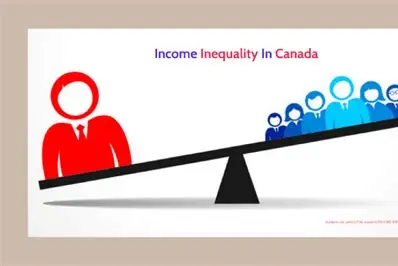
Income inequality stands out as a major issue in Canada’s economy and society these days. It has definitely become a popular topic now among Canadians. Living costs keep climbing higher, and economic growth is unequal now in Canada. That makes the divide between high earners and low ones much clearer to everyone. To understand the negative effects of income inequality I will be delving into the social and economic impact of income inequality.(1)
Canada deals with pretty significant income inequality that sticks around year after year. The country’s social welfare setup does help narrow some gaps compared to places like the United States. Still over the past few decades, the top one percent and top ten percent of earners have gotten most of the income increases which means the rest of the population has not seen a significant increase in their wages (2). Middle income families and those with less have only seen small improvements in their earnings. Wealth gaps look even worse in many ways. Just a handful of households control a huge chunk of the nation’s total wealth. At the same time plenty of Canadians have very little in savings or assets. And are in increasing levels of debt. Things like soaring housing prices, higher everyday costs, and more unstable jobs make this split even more obvious. It pulls apart those with steady high pay and property from everyone else who lacks those basics.

The negative effects of massive amounts of income inequality reach into many areas of life. On the economic side it leaves a lot of households feeling financially shaky. They do not have enough saved up to handle unexpected expenses such as losing a job(3). The lower income class also usually spend most of their money. Because of income inequality, in the longer term limited access to good education, skills training, childcare options, and reliable homes hurts how well individuals turn out. Because of this, less people are in the workforce(4).
Social impacts hit hard as well from such high inequality levels. Lower income groups often face worse health results, higher stress, and more chances of long term illnesses. When there is high inequality it is harder for those in poverty to move up socially and financially. That builds up resentment and pushes political views further apart(5). People would start thinking that the system in place favors the wealthy all the time. In extreme situations it even leads to policies that mostly serve rich interests which puts an even bigger wedge on the apparent gap between the wealthy and the rest of the people.
Canada does have some tools in place to ease inequality a bit which I will cover more in future blog posts. But the issue of income inequality has many social and economic effects on the world which could be potentially harmful.
1.)Wikimedia Foundation. (2025, September 2). Effects of economic inequality. Wikipedia. https://en.wikipedia.org/wiki/Effects_of_economic_inequality#HeroSection
2.)Wages for the top 1% skyrocketed 160% since 1979 while the share of wages for the bottom 90% shrunk: Time to remake wage pattern with economic policies that generate robust wage-growth for vast majority | economic policy institute. (n.d.). https://www.epi.org/blog/wages-for-the-top-1-skyrocketed-160-since-1979-while-the-share-of-wages-for-the-bottom-90-shrunk-time-to-remake-wage-pattern-with-economic-policies-that-generate-robust-wage-growth-for-vast-majority/
3.)Uppal, S. (2023a, February 8). This study uses the 2022 Portrait of Canadian Society Survey to examine the impact of rising inflation on the lowest income Canadians. using multiple pre-pandemic data sources, the study also takes a closer look at people living in the bottom income quintile, examining their family income, debt and assets levels, as well as some indicators of economic hardship. Rising prices and the impact on the most financially vulnerable: A profile of those in the bottom family income quintile. https://www150.statcan.gc.ca/n1/pub/75-006-x/2023001/article/00002-eng.htm
4.)Admin. (2020, September 22). Inequality explained: The hidden gaps in Canada’s education system. Open Canada. https://opencanada.org/inequality-explained-hidden-gaps-canadas-education-system/
5.)Brian Nolan. (n.d.). The social impact of income inequality: Poverty, deprivation, and social cohesion | changing inequalities in rich countries: Analytical and Comparative Perspectives | Oxford academic. https://academic.oup.com/book/26541/chapter-abstract/195058166?redirectedFrom=fulltext

Hi Andre, I really enjoyed reading your third post! This post seemed well thought out and I can tell you put a lot of research and time into it. I think what really pulled it together was the ending where you gave multiple examples of negative impacts and inequality. I think if you added specific statistics supporting your opinions your post would stand out more. Overall this post is great! I am looking forward to reading the rest. Keep it up!
Hi Andre,
I really liked that you explained income inequality in Canada in a clear way, especially your connection between rising living costs and wage gaps. Your use of specific examples, like housing pricing and unstable jobs made the issue easy to understand. One thing that may strengthen your post even more is adding short transitions that link economic effects to the social effects more smoothly. Overall, your writing is clear, informative and well supported! Great job and I can’t wait to read more!
Here are a few helpful sources;
https://www.google.com/search?client=safari&rls=en&q=how+prevalent+is+Income+inequality+in+Canada+and+what+are+its+negative+effects%3F&ie=UTF-8&oe=UTF-8
https://www.bankofcanada.ca/wp-content/uploads/2022/07/sdp2022-16.pdf