

Inquiry Question: How does overconsumption affect our lives, and are we enticed by companies advertising, to buy more?
Research Step 2: How does overconsumption affect our mental and physical health, and is the toll as destructive on our well-being as it is on the environment?
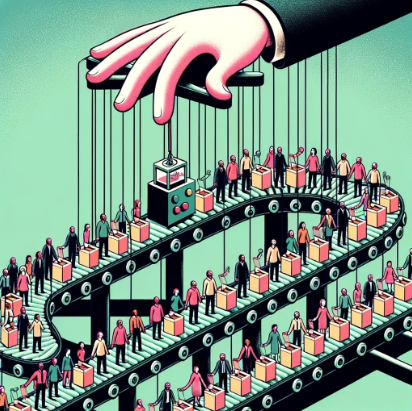
Consumerism is a major factor that contributes to mass overconsumption worldwide. (1) This phenomenon not only affects the environment we live in, but also our mental and physical health. It may seem obvious to most people that the environmental toll is apparent, but many overlook the complications overconsumption has with our well-being, both mentally and physically. (1) Mentally, an increase in anxiety and depression are just a few elements resulting in consumerism. (1) Financial strain and overwhelming feelings result from materialism as many people feel pressured to maintain a certain social status through materialistic goods. (1) This can lead to dissatisfaction with what they already have, and a feeling of urgency to buy more products in order to fit in with certain societal standards. (1)

The image above illustrates what a society might view and develop a sense of urgency to buy more products as well.
In addition, overconsumption may also affect our physical health. (2) As an increasing amount of retail stores and companies are starting to make huge profits online, a growing number of people are starting to get more sedentary. (2) This is a result of millions of online shopping resources as buying products now can be made by one single click of a finger. Countless people find online shopping beneficial and convenient as it saves time and energy without having to commute to a local shopping mall/outlet. (2) Based on a study MadeinCanada conducted, approximately 2.77 billion people spend time shopping online worldwide. (4) That is certainly an overwhelming amount of people! This study goes to show that billions of people online shop globally, being influenced largely due to everchanging trends. Since online shopping requires less effort than browsing in-person, many find this as a better alternative. (2) Therefore, a great amount of people are less physically active, resulting in a more stationary lifestyle, and possibly an increase in obesity. (2)

The picture above illustrates the correlation between online shopping and an increase in a stationary lifestyle.
Overall, overconsumption affects both mental and physical health by slowly deteriorating our concept on what is a necessity vs. what is simply just a want. (3) Today, we constantly come across advertisements from huge companies and corporations that alter our view on how much we consume. (3) In most cases, companies promote purchasing materialistic goods, and offer benefits of buying the product in order to make us feel better about spending money. (3) Ultimately, we are chasing a sense of satisfaction when we purchase items. (3) Although, the complications of overconsumption are often disclosed from the public. (3) It is crucial to remember the issues surrounding consumerism before making a purchase to keep not only the environment healthy, but also our well-being. (3)

Overconsumption and Shopping Statistics:
- In 2024, global online retail sales earnings reached $6 trillion. (5)
- 84.3% of Americans shop online (288 million.) (5)
- Approximately 72% of Canadians have shopped on Amazon. (4)
- In 2022, more than 27 million Canadians shopped online. (4)

I hope you picked up a few key points in this Blog Post! Looking forward to my next Blog Post to dissect this subject matter even further!
–Vanessa Vukovic
Resources:
(1) Andriuška, G. (2024c, September 2). The Psychology Behind Overconsumption: Why we buy more. overconsumption.org. https://overconsumption.org/blogs/news/the-psychology-behind-overconsumption-why-we-buy-more
(2) The price of overconsumption. (2025b, May 12). Refined by Science. https://refinedbyscience.com/2025/05/12/the-price-of-overconsumption/
(3) Overconsumption core: how our brains drive us to consume. (2025, February 11). PennNeuroKnow. https://pennneuroknow.com/2025/02/11/overconsumption-core-how-our-brains-drive-us-to-consume/
(4) Bush, O. (2024, December 31). Online shopping statistics in Canada. Made in CA. https://madeinca.ca/online-shopping-canada-statistics/
(5) Online Shopping Statistics (2025): Growth, sales & Demographics. (2025, November 25). Capital One Shopping. https://capitaloneshopping.com/research/online-shopping-statistics