Hello! Welcome to my blog post! For my semester one inquiry, I have decided to research the question “To what extent does daily water intake influence skin hydration and acne occurrence in students?” In this blog post, I will be sharing my second round of research, focusing mainly on the reasons for acne occurrence in the first place and its prominence.
What is acne?
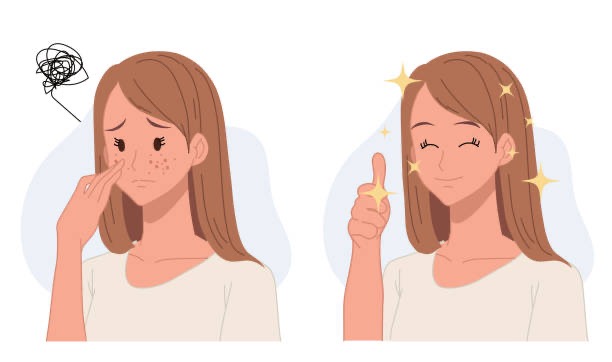
Acne vulgaris, which is most commonly known as simply acne, is a multifactorial disease that affects over 85% of adolescents worldwide. This condition usually starts at puberty and resolves around the age of 20 but can still affect individuals of various ages (1)(4). Acne can appear not just on your face, but behind your neck, back, and chest. It is something that is continued to be misunderstood in today’s time. A study with 328 patients was carried out to assess the severity of their acne and have them complete a questionnaire pertaining what they knew about the topic. The results showed that 89.7% of patents expressed that pimples were all that there was to acne. Additionally, for another question about whether frequent wash washing has any affect on the face, over 100 patients replied with face washing to have zero effect on acne or rather it makes it worse (2).
Although acne is an unavoidable disease, it can be effectively controlled with the right knowledge. Washing your face regularly with a pH balancing cleanser, which includes ingredients such as benzoyl peroxide or salicylic acid is one method. Additionally, managing stress and avoiding high dairy based products are two other ways of preventing acne from appearing (6). Avoidance of harsh soaps or scrubs is recommended as those products tend to have a higher pH and can lead to skin irritation and dryness. Major compliances that may arise in Acne Vulgaris include Post-inflammatory hyperpigmentation that can be managed by photo protection topical treatments (such as retinoid, azelaic acid that work to project the skin from solar radiation damage) and chemical peels (which include ingredients like salicylic acid or glycolic acid). Other traditional treatment methods for acne include oral drug therapy (systemic administration of medication such as pills and liquids) (3).

The treatments above can help clear your acne, but what are the different types of acne that can appear?
Acne can appear in several forms, but two of the most common types are comedonal acne and inflammatory acne.
Comedonal acne is the milder, non-inflammatory type of acne that develops when pores become clogged with excess oil and dead skin cells. This creates blackheads, which are open clogged pores that look dark due to oxidation, and whiteheads, which are closed clogged pores under the skin. Because there is little to no redness or swelling, comedonal acne is usually easier to manage with topical treatments that unclog pores, such as salicylic acid or retinoids. Inflammatory acne appears when a clogged pore becomes irritated or infected, triggering the body’s immune response. This leads to papules (swollen bumps) and pustules (pimples filled with pus). More severe inflammation can cause nodules and cysts, which are painful lumps deep in the skin. Inflammatory acne is more likely to scar and often requires stronger medications to reduce bacteria, inflammation, and excess oil (4). These two types differ mainly in whether inflammation is present, how painful the lesions are (abnormal patches of skin like the blackheads), and how likely they are to cause scarring
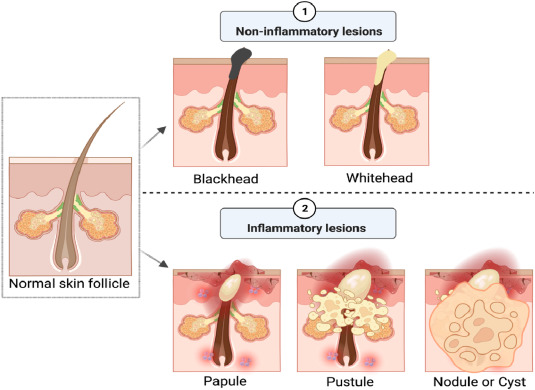
The image above is a visual representation of the different kinds of lesions that could appear due to acne.
In this second round of research, we investigated the root cause of acne. This research will be very beneficial as it will allow me to connect what factors water provides that is linked to acne occurrence. In the next round or research, I will Investigate the relationship between daily water intake, skin hydration, and acne occurrence in students. and I will also initially share my own thoughts of the two topics now that I have more knowledge of both.
Reference list
- https://pmc.ncbi.nlm.nih.gov/articles/PMC2585707
- https://pmc.ncbi.nlm.nih.gov/articles/PMC7445635
- https://www.ncbi.nlm.nih.gov/books/NBK459173/#:~:text=Acne%20vulgaris%20is%20a%20common,arms%2C%20trunk%2C%20and%20back.
- https://www.sciencedirect.com/science/article/pii/S2405580823001590#sec2
- https://pubmed.ncbi.nlm.nih.gov/17340019/
- https://pmc.ncbi.nlm.nih.gov/articles/PMC11266290/
Thank you for reading my second round of research blog! Please feel free to comment down below how this blog made you feel!