
:
1. Introduction
The article discusses the need to improve how carbon sequestration and greenhouse gas (GHG) removals are defined and accounted for in climate policy. Under the Paris Agreement, particularly Article 6.4, countries are developing the Paris Agreement Crediting Mechanism (PACM) to promote carbon mitigation projects and international carbon credit trading. A major challenge in these systems is accounting for how long removed carbon remains stored outside the atmosphere. Traditional accounting methods often focus only on the quantity of carbon stored, not the duration of storage, even though carbon stored temporarily still provides climate benefits by delaying atmospheric warming. The article proposes integrating scientific insights from ecosystem ecology and carbon cycle science to better quantify the temporal dimension of carbon storage.
2. Storing Carbon in a Compartmental System
The paper introduces the concept of compartmental dynamical systems, a framework widely used in carbon cycle science to represent how carbon moves and is stored in different components of a system. In this framework, systems such as forests, soils, crops, cities, or technological carbon storage facilities are represented as compartments that store carbon and exchange it through fluxes. Carbon enters the system from the atmosphere (removals) and leaves through emissions or disturbances (reversals). A key advantage of this framework is that it ensures mass balance, meaning changes in total carbon storage can only occur through changes in inputs or outputs. It also allows researchers to calculate transit time, which measures how long carbon stays in a system before returning to the atmosphere. This concept is crucial for evaluating the permanence of carbon storage across different mitigation strategies.
3. Gross and Net Removals
Carbon dynamics within ecosystems are described using two types of fluxes: gross removals, which represent carbon taken from the atmosphere, and gross reversals, which represent carbon released back into the atmosphere. The difference between these two fluxes produces the net removal flux, which determines whether carbon storage in the system increases or decreases. Traditional carbon accounting often focuses on stock change, measuring how carbon storage differs between two points in time. However, this approach fails to consider how long carbon has been stored during that period. Two systems may end with the same amount of stored carbon, but if one stored it earlier, it would have kept carbon out of the atmosphere for longer, providing greater climate benefit. Therefore, stock-based metrics alone cannot fully capture the climate impact of carbon sequestration.
4. Carbon Sequestration as Time-Integrated Carbon Storage
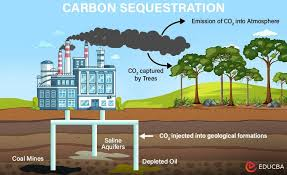
The article proposes a new definition of carbon sequestration (CS) that incorporates both the amount of carbon stored and the duration of storage. Instead of simply measuring changes in carbon stocks, CS is defined as the area under the curve of carbon storage over time, integrating carbon mass and time. This produces a metric measured in mass × time units (e.g., carbon-years). This approach reflects the fact that climate benefits arise when carbon remains outside the atmosphere for extended periods. By measuring the time-integrated storage, the method captures differences in the speed of carbon accumulation and the duration of storage, allowing better comparisons between carbon removal strategies.
4.1 Carbon Sequestration Considering Only Inputs
In some cases, carbon accounting may focus only on new carbon entering a system during a project period, ignoring legacy carbon already present. This approach is useful when projects only control newly captured carbon, such as in technological carbon capture systems. Carbon sequestration is then calculated by integrating the balance between new carbon inputs and outputs over time.
4.2 Carbon Sequestration Considering Total Carbon Stocks
Another approach accounts for both new inputs and legacy carbon already stored in the system. In this case, carbon sequestration is determined by integrating changes in total carbon storage over time relative to a baseline. This method reflects the combined effect of new carbon uptake and potential carbon losses from previously stored stocks. Importantly, it shows that systems that accumulate carbon faster or maintain larger stocks for longer periods produce greater time-integrated climate benefits.
5. Accounting with Respect to a Baseline
Carbon markets often rely on baseline scenarios, representing what carbon storage would have been without a project. Credits are typically awarded based on the difference between project carbon stocks and baseline stocks. The article argues that this approach should instead compare time-integrated carbon storage relative to the baseline, not just the final carbon stock. Using carbon sequestration metrics can reveal larger differences in climate benefits between management strategies. For example, agricultural systems that prevent soil carbon loss over time may deliver greater climate benefits than stock-based accounting suggests because they retain carbon for longer periods.
6. The Value of Time
The paper distinguishes between physical carbon storage processes and economic valuation of carbon storage. The time carbon remains in ecosystems depends on biological and environmental factors such as plant growth, microbial activity, and soil conditions. These factors determine carbon’s transit time through the ecosystem. In contrast, the economic value of storing carbon depends on policy, market demand, and societal preferences. The article emphasizes that these two aspects—physical storage time and financial valuation—should be treated separately in carbon accounting frameworks.
7. Difference from Tone-Year Accounting
Although the proposed carbon sequestration metric also uses units of mass multiplied by time, it differs fundamentally from traditional tone-year accounting methods. Tone-year approaches attempt to equate the climate effect of carbon emissions with temporary carbon storage by comparing atmospheric carbon residence time with stored carbon quantities. The article argues that this creates a false equivalence between emissions and sequestration. In contrast, the proposed framework focuses only on carbon stored in terrestrial or technological systems and the duration of storage, independent of atmospheric carbon dynamics. To link carbon storage with climate impacts, the paper introduces the concept of climate benefit of sequestration, which measures the avoided radiative forcing caused by keeping carbon out of the atmosphere.
SOURCES
1.https://royalsocietypublishing.org/rsos/article/12/6/242095/235436
2.https://link.springer.com/chapter/10.1007/978-3-032-07619-9_1