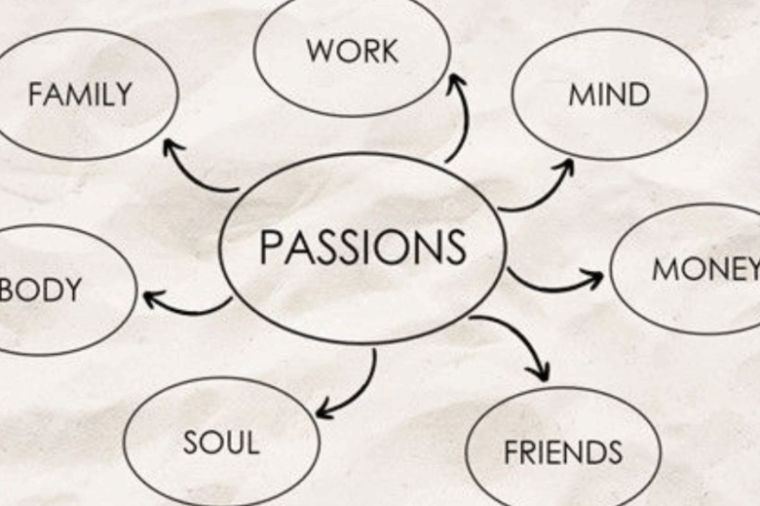
Hello and thank you for taking the time to read my third blog post. My inquiry question for this semester is “How do our passions shape who we are and influence the choices we make?”. In this post, I will be focusing on the sub-question “what is passion and where does it come from?”.

Passion is more than just liking something, it’s a powerful psychological force. According to Robert J. Vallerand, passion is “a strong inclination toward and activity that people like, find important, and in which they invest time and energy” (1). In his award-winning book the “Dualistic Model of Passion”, Vallerand mentions that there are two different types of passion. Harmonious and obsessive. Let’s take a deeper dive into these two types of passion.
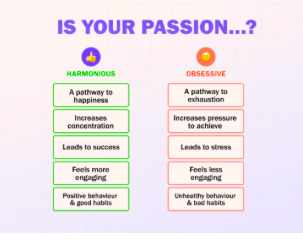
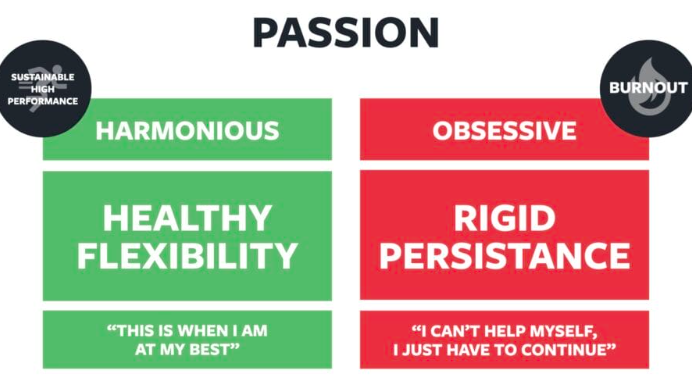
Harmonious passion is “the result of an autonomous internalization of an activity into one’s identity” (3). In other words, an individual chooses to engage in the activity freely, without pressure or obligation. Over the course of time, the activity becomes more personally meaningful and is naturally integrated into the individual’s identity. Rather than feeling compelled or controlled, the individual experiences a healthy connection to the activity. An experience that “fits comfortably alongside other responsibilities” (4), almost harmoniously. This type of passion supports well-being because the activity enhances the individual’s identity and life functioning, rather than disrupting it.
On the other hand, obsessive passion results from “a controlled internalization of the activity into one’s identity” (1). This is often driven by internal or external pressures such as social acceptance and self-esteem. This form of passion can lead individuals to feel an “uncontrollable urge” (1) to engage in the activity, to the point where the passion seems to control them. This urge “leads to less than adaptive, and at times maladaptive, processes like ruminations or rigid persistence preventing him from experiencing optimal outcomes and at times less adaptive, negative emotions” (3). This means that an individual may feel forced to engage in an activity which can lead to overthinking, inflexible behavior and conflicts with other parts of life.
Now that we have learned about the difference between harmonious and obsessive passion, let’s look at where it comes from.
The development of passion is strongly linked to the “Self-Determination-Theory” (1). This theory suggests that we have three basic psychological needs to keep us motivated: Autonomy, Competence and Relatedness. Autonomy is the feeling that we are free to choose, rather than being forced or pressured. This promotes harmonious passion as “when an individual chooses to engage in an activity they enjoy, the activity can naturally be integrated into their identity” (5). Competence is the feeling that we are capable of achieving goals and handling challenges effectively. When an individual experiences progress or growth in an activity, they are “more likely to continue engaging with it and integrating it into their identity” (2). This ongoing success leads to positive emotions, strengthening harmonious passion. Relatedness is the sense of belonging and having a connection with other people. Activities that promote social bonds and allow individuals to contribute to a community are more likely to become passions. People are more motivated to continue because the activity satisfies their need for connection.
When all three needs are satisfied repeatedly through an activity, it’s more likely to be internalized into one’s identity, forming a harmonious passion that contributes to long-term well-being. On the other hand, if any of these needs are frustrated, the resulting passion may become obsessive.

Thank you for reading! In Round 2, I will be exploring how passions shape life decisions (education, jobs, relationships…)
References:
- On the Psychology of Passion In Search of What Makes People’s Lives Most Worth Living – Ovid.
- The relationship between passion and well-being: A meta-analysis. Psychological Wellbeing – SpringerOpen
- SAGE Encyclopedia of Theory in Psychology. Passion – SAGE.
- Les passions de l’âme: On obsessive and harmonious passion – Journal of Personality and Social Psychology.
- Passion – Berkeley Well-Being.


Hi Ihan,
I thought this post was really perceptive, and I liked how you showed good examples of each type of passion. Next time, you could perhaps break down complicated words like autonomy, so that the reader can get a better understanding of your topic.
Anyways, here’s another article on the dualities of passion. I hope that it helps you in your next round of research!
https://psycnet.apa.org/record/2013-09273-004
Great job on this post! Your distinction between harmonious and obsessive passion was very clear, and I appreciated how you returned again and again to self-determination theory, it helped make the topic accessible. I loved the visuals you threw in there that really broke things down in a fun way. Something to improve on for next time is to add a small personal example or real-life scenario. It might also help readers connect even more with the ideas you are explaining. I loved the topic of your post and I am intrigued for the next post!