
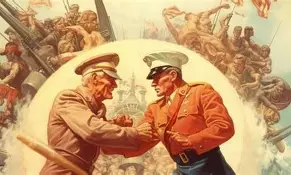
The choice of the research topic, “How the geopolitical tension of the Cold War influenced development,” stems from a combination of historical significance, scholarly gaps, and contemporary relevance to understanding global inequalities and development trajectories. The Cold War, spanning roughly from 1947 to 1991, was more than a period of ideological confrontation between the United States and the Soviet Union; it was a global phenomenon that shaped political, economic, and social structures across continents. Selecting this research topic enables a nuanced exploration of how international rivalry between superpowers extended far beyond military standoffs, substantially impacting the development aspirations and policy frameworks of both developing and developed nations. This topic is particularly compelling as it integrates the domains of political science, international relations, economic history, and development studies within a coherent analytical framework.
One primary motivation for addressing this topic is the critical need to understand the mechanisms through which geopolitics constrains or catalyzes development initiatives. During the Cold War, countries in Africa, Latin America, and Asia often experienced development interventions—or the lack thereof—determined by their alignment or perceived alignment with one of the superpowers. Economic aid, technical assistance, and military support became instruments of strategic influence rather than purely development-oriented tools. As such, understanding these linkages is crucial for researchers interrogating the origins of current development disparities. By focusing on this topic, I aim to illuminate how global ideological competition directly influenced local developmental policies, economic infrastructure, educational initiatives, and even social transformations across various regions, thereby offering valuable insights for scholars and practitioners seeking to design context-sensitive development strategies in post-Cold War society.
Another strong justification for choosing this research area is its potential to bridge historical analysis with contemporary policy evaluation. Much of the existing literature on development tend to prioritize economic indicators, governance structures, or post-colonial policy choices without adequately situating these frameworks within the Cold War context. Geopolitical tensions dictated not only the allocation of resources but also the ideological orientation of development planning, often forcing nations to adopt economic models or political systems aligned with either capitalism or socialism irrespective of localized needs or capacities. By investigating these dynamics, my research contributes to the historiography of development while also offering a lens for understanding why certain nations experienced accelerated industrialization, infrastructure expansion, or educational improvements, whereas others faced stagnation, conflict, or economic dependency under the shadow of superpower rivalry.
Furthermore, the research holds personal and scholarly resonance due to its interdisciplinary richness. Examining the Cold War’s impact on development necessitates engagement with international relations theory, economic growth models, and case studies of nation-specific experiences in Latin America, Africa, and Southeast Asia. These multi-dimensional analyses provide a fertile ground for generating insights into the complex interplay between international pressures and domestic policy-making. Through this topic, I can explore questions of agency, sovereignty, and strategic adaptation, highlighting how policymakers in developing countries maneuvered within the constraints imposed by the global bipolar order. This perspective enriches the broader discourse on development studies, offering empirical and theoretical contributions to understanding the historical roots of contemporary global inequalities.
Finally, this research topic holds enduring relevance in the present era, as the legacies of Cold War interventions continue to shape development outcomes, regional conflicts, and international aid patterns. Many post-Cold War development challenges—including debt crises, infrastructural inequities, and political instability—are inextricably linked to historical geopolitical alignments and superpower-mediated development strategies. By examining the Cold War’s influence on development, my research offers valuable lessons for current and future policy-makers, emphasizing the importance of contextually informed development pathways that are resilient to external ideological pressures.
In conclusion, my selection of this research topic is driven by its historical significance, its potential to bridge scholarly gaps, its interdisciplinary nature, and its contemporary relevance. Investigating how Cold War geopolitical tensions influenced development enables a critical understanding of the intersections between global power dynamics and local development policies while contributing to a broader comprehension of enduring patterns of political, economic, and social transformation. This topic is thus both timely and essential for developing a nuanced, historically informed approach to analyzing development trajectories in the modern world.