

Hi, welcome to my blog post! To address my overall question “Why are literacy rates dropping and what does this mean for us?” in this round of research Ill be finding the evidence of these rates dropping. This step is crucial so I can later explain why this is happening and discuss what the effect of this crises has and will have on our society.

The reason I wanted to do my blog project on this subject is because I’ve heard lots of talk about “the death of reading” and how kids across developed countries are losing their functional literacy. Think Academy defines functional literacy as ” the ability to use reading and writing effectively in everyday situations….It means understanding written information well enough to respond, communicate, or take appropriate action.” (1) For small children in the class room this means following classroom directions, reading a schedule, understanding game rules, or writing a note that another person can follow. As they grow older this skill becomes the ability to summarize or compare texts, understand and complete questions on a test and explain processes to others.(1) As we can see from this definition, losing your functional literacy doesn’t mean that you cant read, it means that you don’t properly understand what you are reading and you wont be able to paraphrase it.
The Organization for Economic Co-operation and Development (OECD) did a survey on adult skill (numeracy and literacy assessments) and found that scores have largely declined or stagnated over the past decade in most OECD countries. The Survey was conducted in 2023 and measured the skills of around 160 000 16-65 year-olds across 31 countries them being: Austria, Belgium (Flemish Region), Canada, Chile, Croatia, Czechia, Denmark, England (UK), Estonia, Finland, France, Germany, Hungary, Ireland, Israel, Italy, Japan, Korea, Latvia, Lithuania, the Netherlands, New Zealand, Poland, Portugal, Singapore, the Slovak Republic, Spain, Sweden and the United States. Out of these countries twenty-seven of these them also took part in the first Survey done in 2013. The only countries with significant improvement in their score were Denmark and Finland. On average the numeracy assessment went better, 8 countries saw improvements, with Singapore and Finland having the biggest uptick in scores. However on the literacy assessment, the literacy proficiency of the lowest socioeconomic percentage of the population had a 10% decline, there are similar declines in numeracy with this population. On average across participating countries one in five adults of this population were only able to understand simple texts or solve basic arithmetic. What is interesting is that the scores of the top 10% has improved, this will continue to widened inequality. {thought to come back to in blog post 4: this hints at a decline/inadequacy in the public school system or support system for families living in poverty and sending their kids to school}. Singapore and the US had the largest gaps between these sections of the population.(2)
Some other interesting statistics from this survey:
- Literacy proficiency has declined more strongly among men than women
- However, men continue to get better scores on average than women in numeracy
- Also, on average foreign-born adults have lower scores than native-born adults in nearly all countries
- This could be important to keep in mind as increase of immigration in these countries could in part explain declining scores
- This could be important to keep in mind as increase of immigration in these countries could in part explain declining scores

Statistics in the US (3)
Adults
- 28% of U.S. adults read at the lowest literacy level up from 19% in 2017.
- 19% function at the lowest level in Canada (7)
- 56% of U.S. adults score below Level 3 (sixth-grade reading level)
- 49% of adult Canadians have literacy skills that fall below a high school level (7)
- Only 44% of U.S. adults read at a strong level, down from 48% in 2017.
- The U.S. adult literacy score = 258
- international average = 260
- Canada score = 271
Children (according to National Assessment of Educational Progress)
- Only 31% of fourth graders read at or above proficiency in 2024.
- 40% of fourth graders read below basic ability, increase to recorded percentage in 2022.
- About 1 in 3 eighth graders read below basic, highest amount ever recorded!

Statistics in BC
Declining literacy and numeracy rates shown by provincial assessments aren’t new to BC, or to Canada. Standardized test results have been declining throughout the whole country for more than 20 years past.
Reading was the main PISA subject in the literacy assessments done in 2000, 2009 and 2018 tests the average scores have been declining every year, math assessments show a similar pattern. In 2000, BC was compared to 31 other countries and got third place in average literacy score, by 2009 with 65 countries BC was eighth and in 2018 BC was in 11th place. “Emily Villavicencio, a primary grade teacher in a French immersion school in B.C.’s Lower Mainland, said she has noticed her students’ oral and written literacy skills slip over the past 15 years.” this matches the decline in literacy scores. (4)
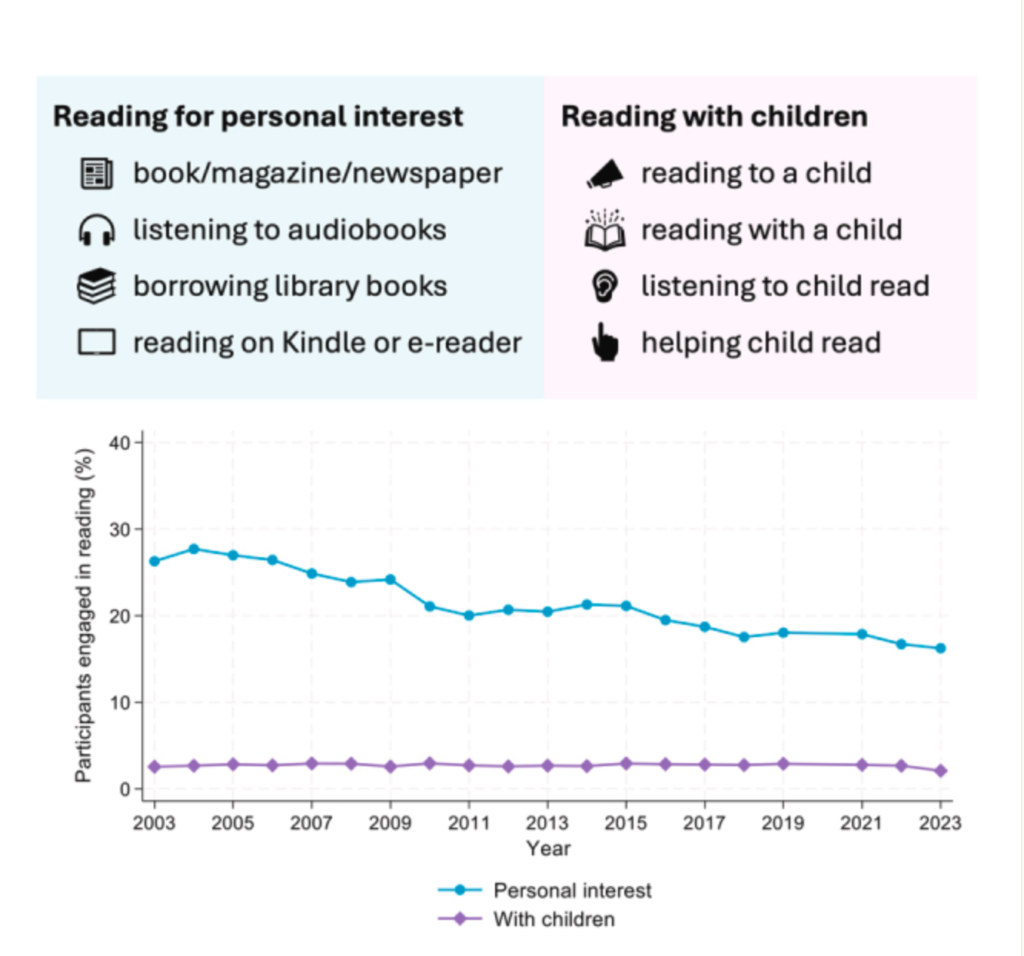
At the same time statistics also show a significant decline in reading for enjoyment and the time spent reading by the average person. This year IScience‘s research shows that the share of Americans who read for pleasure on an average day has fallen by more than 40 per cent over the past 20 years. Another statistic done by National Library of Medicine says that the decline in the proportion of individuals reading for pleasure daily in the US, is of 3% every year, also there were large disparities across population groups. This percentage increased when looking at the Black population vs White, the population with lower education as well as lower annual incomes. There were also greater declines seen with adolescences between ages 17–18, the proportion who read a book/magazine every day decreasing from 60% in the late 1970s to 16% by 2016.They also looked at time spent reading with children and found that it has become less common recently but not significantly. (5)(6)
thank you for reading!
- https://www.thethinkacademy.com/blog/what-is-functional-literacy-skills-for-everyday-life/
- https://www.oecd.org/en/about/news/press-releases/2024/12/adult-skills-in-literacy-and-numeracy-declining-or-stagnating-in-most-oecd-countries.html
- https://www.thenationalliteracyinstitute.com/literacystatistics
- https://thetyee.ca/News/2025/10/07/Math-Reading-Scores-Declining-BC/
- https://aeon.co/essays/what-we-think-is-a-decline-in-literacy-is-a-design-problem
- https://pmc.ncbi.nlm.nih.gov/articles/PMC12496190/
- https://abclifeliteracy.ca/literacy/
