
Hi everyone, welcome back to my blog post. Today I will be writing my final blog post for this inquiry project and researching some ways students can find the best study methods that fit their own individual need. Since there are so many different studying practices that promote memory recall, I am going to stick with three primary techniques that are most popular among students all over world and hopefully the most efficient as well. Furthermore, I will continue to explore and develop study habits that will help students to absorb new information quickly as well focusing on certain aspects of learning to improve the efficiency of studying. Without out further a do, let’s explore techniques to make studying easier and more effective!
Blurting
Blurting is the method in which you quickly skim through a section of a textbook, an exam specification, or a study aid and then write as much as you can remember from material on paper (1). After copying down the information on a separate piece of paper, compare what you wrote down to the section from the textbook or study guide and evaluate which areas you remembered as well as areas that you may need to further work on (1). Furthermore, you can continue to use this method, until you are able recollect and absorb all the information that is required.
This type of method is frequently used by students who are studying for exams because of how quickly and effective it is compared to just writing everything down. It is one of the best memory recall techniques that have popularized by the internet as it clearly shows which areas need revision and it stores critical information in your short term memory then long term memory (1). In my opinion, I would recommend this technique for students who have already read over the necessary materials and want to revise their knowledge before a test or quiz.
The Feynman technique
Richard Feynman was an award winning Nobel prize physicist who was highly knowledgable in the fields of quantum mechanics and particle Science. He made significant discoveries in these areas teaching at prestigious institutions such as CalTech University and even introducing the concept of nanotechnology. Despite all of his accomplishment, Feynman considered himself as an ordinary person who studied hard, firmly believing that anyone was capable of learning with enough effort – even in complex subjects like physics (2).
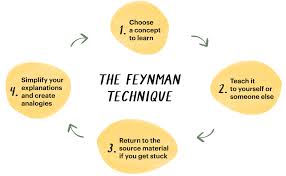
The Feynman technique is broken down into 4 steps to understand any subject. These steps include:
- Choosing a Concept to learn
Select a concept you are trying to understand or subject you are studying and write it on the top of the piece of paper
2. Teach it yourselves or someone els
Write everything you know about the subject as if you are explaining to yourselves or teaching someone else
3. Return to source material if you get stuck
When you feel stuck or do not understand a certain concept – go back whenever you were learning from whether this be a textbook, lecture notes, video etc and fill the gaps of your knowledge.
3. Simplify your questions and create analogies
Skim over your notes and clarifying the explanations you wrote until you fully understand the subject. Additionally, add analogies and questions that may help further increase your knowledge on this concept.
I think this is a really good study method for students who have a important exam coming up but don’t know how to efficiently study or are confused on certain concepts of information taught in school. Although this method is not exactly the best for quickly absorbing new information and data, it does provide students with a deeper understanding of complex ideas that may seem challenging at first glance. The Feynman technique is definitely a process that requires time and effort in order to achieve the desired outcome, but it is also one most effective way for students who willing to take the time to acknowledge different perspectives as well as approches to learning
Pomodoro Technique
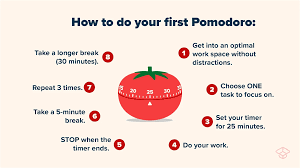
The Pomodoro technique is a method that helps manage time by working for around 25 minutes and taking breaks in between 5 minute intrevals (3). For longer periods of study, breaks are typically 15-30 min after working 4 consecutive work intervals called pomodoros. Strangely the word ‘pomodoro’ is the equivalent of the Italian word for a common fruit that can be found in our kitchen fridges, the tomato. This method was named after a tomato shaped kitchen timer used by Franseco Cirillo (the developer of the Pomodoro practice) to organize his time and study schedule (3). After many experiments using this timer to find ways to be more focus during studying, Franseco realized that time could be turned into an ally, rather than a source anxiety that many people usually experience in their daily lives.
The purpose of the Pomodoro method is to train people ( in this case students ) to better concentrate on tasks by limiting the time they attempt to maintain that focus through restorative breaks and other activities that may be distracting (3). Furthermore, this also allows students to overcome common distractions like procrastination or lack of motivation to work, allowing the promotion of healthy study habits and producing a sense of accomplishment that can be used to better understand concepts taught in an academic setting. I actually have used this method before and I find it a really efficient way to limit internal and external distractions that may interrupt your study sessions for important exams as well as tests.
Conclusion
I really hoped that my research have been useful for students who wants to find ways to improve their memory recall, study habits, productivity, etc. As a student myself, I know the struggle to balance personal social life with my school schedule, so finding ways to manage my time efficiently helped me to get through the semester productively, without burning out and stressing to get homework done. My aim is that the insights from this research can serve as light of guidance for my fellow peers, help navigating them through challenges that may arise during their academic journey in school. By doing this, I intend to support the development of a community of capable and happy students who can confidently take on academic challenges while relishing the benefits of connection and personal growth.