
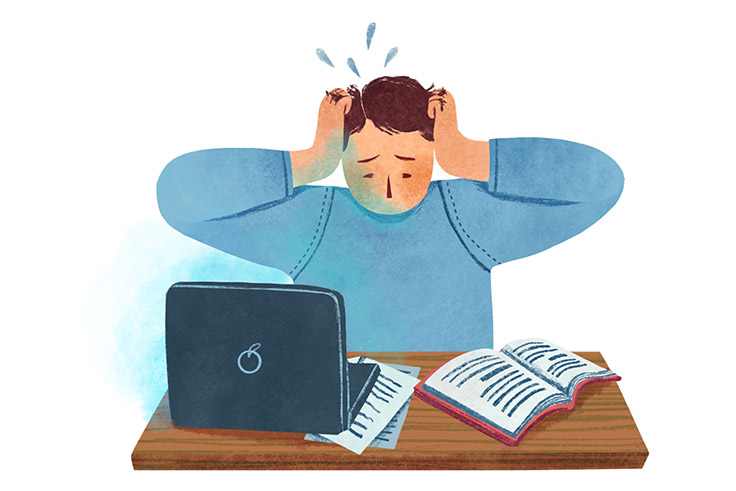
The question I chose to answer for my inquiry project this semester is “How does stress affect student learning and performance?” In my first round of research, my focus will be on clearly defining stress. Should it be looked at as something bad? Is it something we want to avoid entirely? These (and more) are all questions I will be trying to answer in this round. My goal with this round is to help provide a better understanding of stress for readers, and myself. For this project to be successful, we have to know what exactly we are talking about.
- Stress can be defined as a state of worry or mental tension caused by a difficult situation.
- It is a natural human response that helps us to address the challenges and threats in our lives.
- Everyone experiences stress to some degree, although it is vastly different for everybody.
- The thing that makes the biggest difference to our wellbeing however is our response to it (1).
- Stress can be a short-term response to something that happens once or only a few times, or a long-term response to something recurring. Our bodies can typically handle short-term stress without long-term effects.
- But long-term or chronic stress (distress) can make you sick, mentally and physically (3).

- Stress is the body’s response to a real or perceived threat that is meant to prepare you for any action to get you out of harm’s way.
- Some stress can be beneficial, like motivation to focus on a task or take initiative and solve a problem. Stress in situations like these are manageable, and can even be helpful.
- But when stress is unhelpful or harmful, it can make people feel overwhelmed. These scenarios can cause people to avoid dealing with the original problem altogether, and could even make the problem worse.
- Excessive stress can negatively affect decision making, concentration, and confidence. (2)

- When you feel stressed, the body releases specific hormones. The hormones the body releases when stressed are chemical signals that tell the body systems how to respond. This is called the stress response.
- During the stress response, the body gets ready to flee or fight by increasing heart rate, breathing rate, and blood pressure.
- Common mental symptoms of emotional stress are feeling overly emotional, anxious, sad or depressed, and restless.
- One might also experience trouble keeping track of and remembering things, and trouble focusing or solving problems (3).
- As I mentioned before, stress does not just affect people mentally, it can also affect people physically.
- Common physical symptoms of stress are aches and pains, chest pains, heart racing, exhaustion, insomnia, headaches, high blood pressure (or hypertension), muscle tension, stomach problems, and even a weakened immune system (4).

- So with all this information, you are probably wondering whether stress is good or bad. The answer? Neither.
- A lot of people have the misconception that stress is something inherently bad for us. In reality, it is part of our fundamental survival system.
- It can be harmful and damaging to the immune response if it is chronic or ongoing, but the short term “fight or flight” response can actually be helpful (5).
- Healthy stress levels help build resilience.
- “Good” stress is called eustress, while “bad” stress is distress.
- Under normal stress, a person starts at a baseline of relaxation, encounters a stressor, the stress response begins, rises to a peak, and then comes back down to baseline (6).
- When your brain perceives a threat, it triggers the “fight-or-flight” response by flooding the body with adrenaline and cortisol.
- This causes your heart rate, blood pressure, and breathing to spike, pumping oxygen-rich blood to your muscles while releasing a surge of glucose for immediate energy.
- At the same time, your senses sharpen and non-essential functions like digestion are suppressed to prioritize survival.
- Once the danger passes, the parasympathetic nervous system ideally kicks in to return your body to a balanced, resting state (7).
I hope this post helped provide a better understanding and clear up some common misconceptions and misunderstandings about stress. My next round of research will be around the main causes of excessive stress in students. I hope to see you there, and thank you for reading!
References:
- World Health Organization (2026) Stress | Retrieved from https://www.who.int/news-room/questions-and-answers/item/stress
- Canadian Mental Health Association (2016) Stress | Retrieved from https://cmha.ca/brochure/stress/
- H. Marks, L. M. King (2024) Stress Symptoms: Physical Effects of Stress on the Body
- Cleveland Clinic (2024) Stress: What it is, Symptoms, Management & Prevention | Retrieved from https://my.clevelandclinic.org/health/diseases/11874-stress
- Stanford Medicine (2012) “Good stress, bad stress” | Retrieved from https://med.stanford.edu/news/all-news/2012/12/good-stress-bad-stress.html#:~:text=The%20overwhelming%20focus%20of%20science,%2C%20vaccination%2C%20infection%20and%20cancer.
- S. Theimer (2023) Your body knows the difference between good stress and bad stress: Do you?
- Harvard Health Publishing (2024) Understanding the Stress Response | Retrieved from https://www.health.harvard.edu/healthy-aging-and-longevity/understanding-the-stress-response