
We live in a fascinating part of space called the solar system. At it’s center is the sun, a yellow star. Around the sun are nine orbiting planet, and around the planet are dozens of orbiting moons.
THE 8 PLANETS.
1.PLANET MARCURY. – The first and the smallest planet in the solar system. (The closest to the sun). It’s rocky and heavily created. It takes 58.65 days to rotate. Its daytime temperature ranges Up To 430°c ( -209°F).
FACT: Despite it is not the hottest planet, however it has the most extreme temperature swings.
FACT#2:While an year is only 88 Earth days, mercury rotates so slowly that one full night that 176 Earth days.{B Jakosky, 1998}
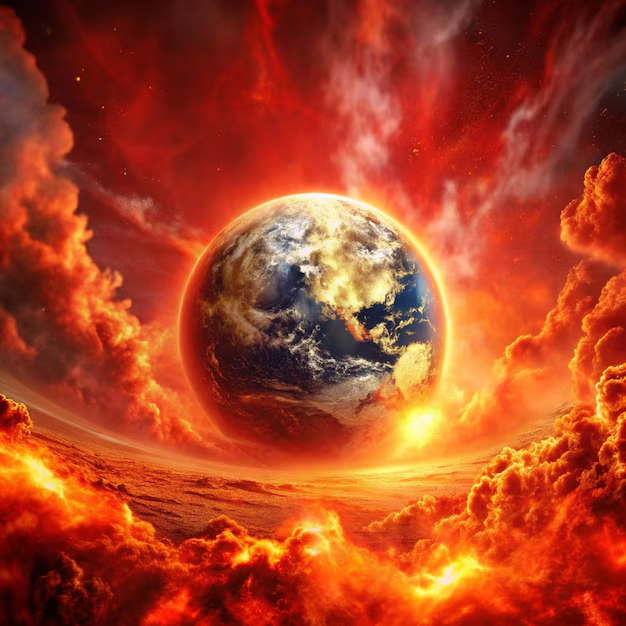
2. PLANET VENUS.– The Earth ” sister” or ” twin” due to their similar size, mass and composition. Venus is in the second distance from the sun.
FACT: – A single rotation takes 243 Earth days, while it only takes 225 Earth days to orbit the sun. One solar days night cycle on Venus takes about 117 Earth days.
FACT: – Even though Mercury is closer to the sun, Venus is the hottest because it’s thick, carbon dioxide rich atmosphere traps heat in a run away green- house effect.
3. PLANET EARTH.-The third planet from the sun and the only place in the universe known to harbor life . Often known as ” Blue planet” because of it’s appearance, 71% of its surface covered by liquid water.
FACT: -Fiveth- Largest planet in our solar system and the largest of the four rocky planets. Earth orbit the sun at an average distance of 93 million miles, takes 365. 25 days to complete one revolution.
4.PLANET MARS– Fourth planet from the sun and a cold, desert world. About half the size of the Earth and is named after the Roman gods of war due to its blood- red appearance. A martian day is 24.6 hours, similar to Earth however it’s year’ s nearly twice as long at 681 Earth days.
Rotation:24.6 hours.
Revolution:687 Earth days.
unique fact: The most unique fact about Mars is that it is” the home of Olympus mons,” the largest volcano in the solar system.
5.PLANET JUPITER – The largest planet in our solar system and the fifeth from the sun. Usually known as a ” gas giant”
FACT– Jupiter is more than twice as massive as all the other planets in the solar system combined. Despite its size, it has the shortest day of any planet l, completing one rotation in about 9.9 hours. While not as visible as Saturn’s, Jupiter has a faint system of dust rings.{JJ Wiseman, 2025}

6. PLANET SATURN. – Sixth planet from the sun and the second largest in the solar system. Sartun has seven main rings (A through G) spanning Up To 282 000 KM from the planet but averaging only 10 M thickness. High speed wind reaches Up To 1800KM/ h. At of 2025 sartun has 274 known moons. Its largest moon, Titan is bigger than planet Mercury and is the only moon in the solar system with a substantial atmosphere and liquid on its surface.
FACT: – It’s the only planet in the solar system less dense than water. If you had a bath hub large enough, sartun would float.
7. PLANET URANUS.: – Seventh planet from the sun, Uranus has an axial tilt of approximately 98°. Scientists believe this was caused by a massive collision with an Earth- sized object billions of years ago. Uranus has 13 known rings.
FACT: Despite being closer to the sun than Neptune, Uranus holds the record for the coldest temperature in the solar system.{JQ2
8. PLANET NEPTUNE.: – Eith and the most distance planet from the sun in the solar system. Neptune is the only planet in our solar system discovered through mathematical prediction rather than direct observation. Astronomers noticed irregularity in the orbit of Uranus and used physics to calculate exactly where Neptune should be.
FACT: –It is the windiest world in the solar system with winds reaching UpTo 2100 KM/h – faster than the speed of sound on Earth.


Hey Maurice, it is such a wonderful blog post to go through. It seems we are revolving on the same field. I wish you all the best as we encroach with the research.