
Interstellar travel is theoretically possible but remains beyond our current engineering. To bridge the gap to the stars, we must move past rockets to nuclear fission, potentially reducing travel time. To sustain such mission, we must learn to harness stellar energy. However, the “dark universe” poses a great threat: at high speed, even the tiny dust particle and cosmic radiation become destructive.
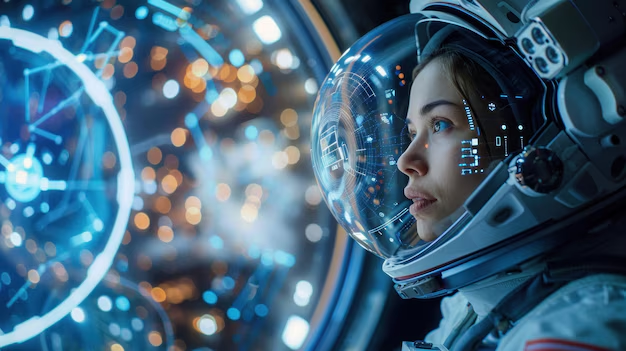
Conclusion: While we have the specific blue- print, reaching another star depends on mastering high speed propulsion and Cosmic protection. We are likely a century away from our first robotic arrival, with human missions remaining a distant multi- generation goal.
“Will we reach the star as masters of physics, or strangers of the very home we left behind?”



Hi , Maurice am delighted to go through your conclusion . Let’s hope it will work for in a better.
Greetings Maurice, i like your conclusion as it brings out the technological hurdle that need to be conquered so that interstellar travel will not be a dream, instead it would be a reality.
Hi Maurice your conclusion is superb. I am impressed by the way you have given a bright information on stellar energy using star as ” refilling station” for gravity assist and fuel harvesting. Your research was absolutely fabulous.
Hey Maurice, you have a superb blog post.it is good that you have come up with an impressing conclusion
Hi Maurice, it was amazing going through your blog. I am much more impressed by your conclusion.