
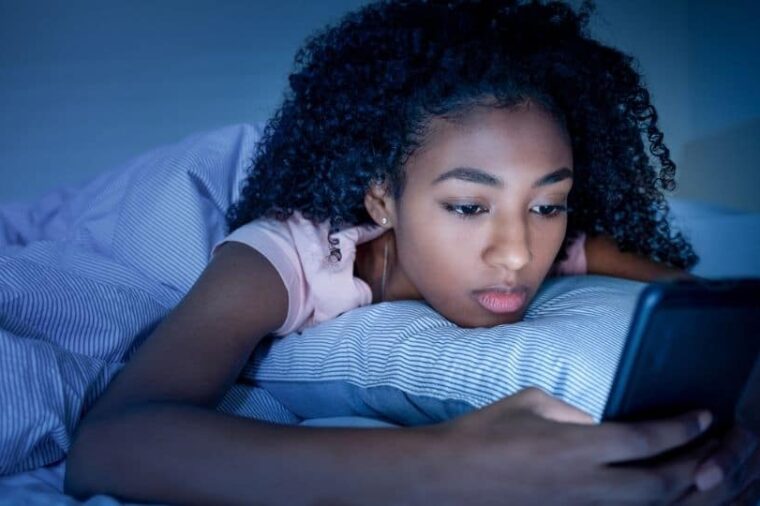
Hi! This is my third blog post on the question: “How does daily screen time affect the sleep quality of teenagers, and what factors can determine whether its effects are harmful or manageable”? Here, I will be talking about my first round of research to research and understand the relationships between screen time and sleep.

For the first round of my research, I focused on understanding the connection between screen time and sleep quality in teenagers. Since phones, computers, tablets, and televisions are used almost every day by students, I wanted to learn why screen use can affect sleep and what factors make the effects either more harmful or more manageable.
One of the most common reasons screen time affects sleep is because of blue light exposure from electronic devices. Blue light can reduce the production of melatonin, which is the hormone that helps people feel tired and fall asleep naturally (1). When teenagers use screens late at night, their brains may stay more alert, making it harder to fall asleep and reducing overall sleep quality. Research also shows that teenagers who spend more time on screens often sleep for fewer hours and may wake up feeling more tired during the day (2).

Another important factor is the type of screen activity being used. Activities such as social media scrolling, gaming, or watching exciting videos may increase mental stimulation before bed, making it harder for the brain to relax (3). Some studies explain that interactive activities, especially gaming and social media use, can keep teenagers emotionally engaged and delay bedtime even further (4). However, not all screen use affects people in the same way. For example, educational use earlier in the evening may not be as harmful as using devices right before sleeping.

The timing of screen use also appears to be very important. Several sources explain that using screens close to bedtime has the strongest negative effect on sleep quality (2). Teenagers who use devices during late-night hours are more likely to experience delayed sleep, interrupted sleep patterns, and daytime tiredness (5). In comparison, limiting screen use before bed or using features like night mode may help reduce some of these effects.

This research shows that healthy habits can help make screen time more manageable and healthy. Many experts recommend creating consistent bedtime routines, reducing device use before sleeping, and avoiding excessive nighttime notifications (3). These strategies may help teenagers balance technology use while still making sure that they get enough sleep and maintain their overall health.

Overall, this first round of research helped me better understand the relationship between screen time and sleep quality in teenagers. I learned that the effects of screen time depend on several factors, including the amount of screen use, the timing, and the type of activity. In my next round of research, I will work on step #2, which is to find factors that will influence the impact of screen time on sleep.
References:
- Alshoaibi, Y., Bafil, W., & Rahim, M. (2023, July). The effect of screen use on sleep quality among adolescents in Riyadh, Saudi Arabia. Journal of family medicine and primary care. https://pmc.ncbi.nlm.nih.gov/articles/PMC8776263/
- Robards, K. (2025, September 22). Screen Time and sleep: What new studies reveal. Sleep Education. https://sleepeducation.org/screen-time-and-sleep-what-new-studies-reveal/
- How screens affect your sleep. Sutter Health. (2026, March 3). https://www.sutterhealth.org/health/screens-and-your-sleep-the-impact-of-nighttime-use
- 0 masterthesis master’s programme in Nordic Welfare, 60 credits. (n.d.-a). https://www.diva-portal.org/smash/get/diva2:1868449/FULLTEXT02.pdf
- https://www.thensf.org/screen-use-disrupts-precious-sleep-time/ Bobby. (2022a, March 13). Screen use disrupts precious sleep time. National Sleep Foundation. https://www.thensf.org/screen-use-disrupts-precious-sleep-time/
Thank you for reading!