
Hi, welcome back to my blog! For the second round of my research, I focused on the biological and cognitive factors behind procrastination. Researchers have found that procrastination is not only caused by emotions or habits, but also by the way the brain processes rewards, decision-making, and self-control. Human brains are naturally designed to prefer immediate rewards over future benefits, which helps explain why people delay important tasks even when they understand the negative consequences.
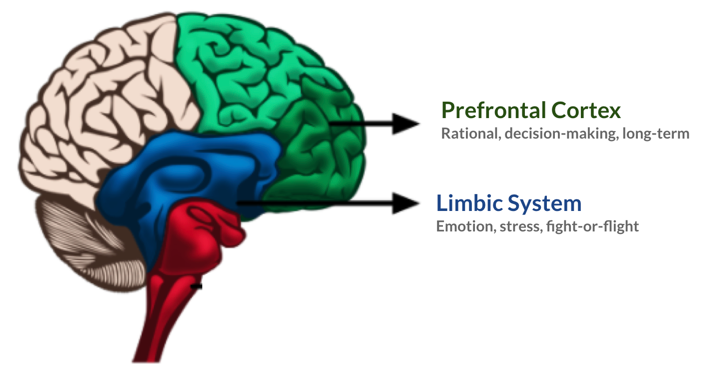
One important biological factor involved in procrastination is the relationship between the prefrontal cortex and the limbic system. The prefrontal cortex is responsible for planning, decision-making, focus, and self-control, while the limbic system controls emotions and reward-seeking behavior. Researchers explain that when people procrastinate, the limbic system often overpowers the prefrontal cortex because the brain wants immediate comfort instead of long-term success [1]. For example, watching videos or scrolling through social media gives quick satisfaction, while homework or studying may feel stressful.

Scientists have also connected procrastination to dopamine, a neurotransmitter involved in motivation and rewards [2]. Dopamine encourages people to find activities that feel good in the moment. Because immediate rewards create stronger dopamine responses than future rewards, the brain may prioritize entertainment or relaxation over completing tasks that only provide benefits later. This helps explain why procrastination can feel automatic even when people know they should begin their work.
Another cognitive factor is called “temporal discounting.” This means people tend to value immediate rewards more highly than future rewards [3]. For example, finishing an assignment early may reduce stress later, but the reward feels distant and less motivating in the moment. In contrast, activities like gaming, social media, or talking with friends give instant enjoyment, making them harder to resist. Researchers say that this is one reason procrastination is so common.

Studies also show that procrastination is connected to executive functioning skills, which include organization, attention control, memory, and time management [4]. People who struggle with executive functioning may have difficulty starting tasks, staying focused, or managing deadlines. This does not necessarily mean they are lazy but instead it means their brains may have more difficulty organizing actions and resisting distractions.
Sleep, stress, and mental fatigue can also increase procrastination. Research suggests that when people are tired or overwhelmed, the brain has a harder time using self-control and decision-making abilities effectively [5]. As a result, people may avoid difficult tasks because their mental energy is reduced. This creates a cycle where procrastination increases stress, and stress then causes more procrastination.

Overall, this round of research helped me understand that procrastination is strongly connected to how the brain works. Biological systems related to rewards, emotions, and decision-making can make it difficult for people to prioritize long-term goals over short-term. This show that procrastination is more complex than just not having discipline or motivation.
Sources:
- Why We Procrastinate: A Neuroscientific View https://www.sciencenewstoday.org/why-we-procrastinate-a-neuroscientific-view
- Why we procrastinate and what to do about it, with Fuschia Sirois, PhD
- Motivation and emotion/Book/2025/Procrastination and temporal discounting – Wikiversity
- Procrastination: An Executive Function Challengehttps://executivefunctiontoolkit.com/procrastination-an-executive-function-challenge/
- How Does Procrastination Affect Mental Health? – ScienceInsightshttps://scienceinsights.org/how-does-procrastination-affect-mental-health/#google_vignette
Thank you for reading!