
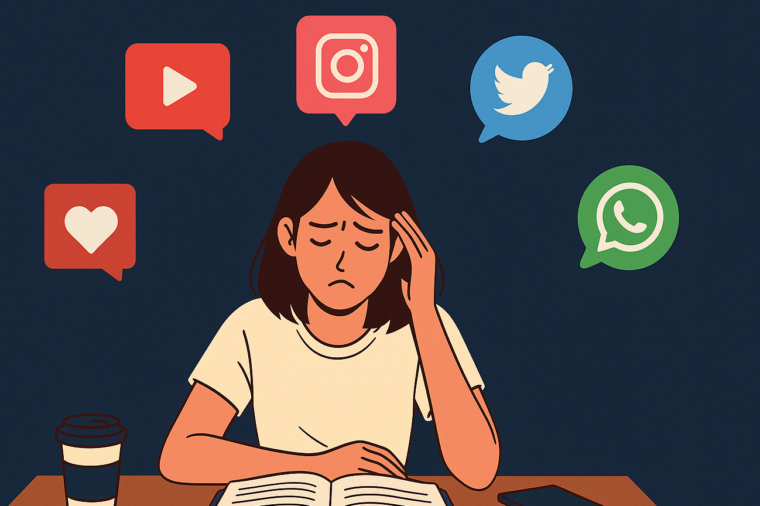
Hi, welcome back to my blog post. My inquiry question for this project, as stated above, is: How does social media negatively affect students’ work habits and their academic performances? In this blog, I will be focusing on how the distractions and bad work habits influenced by social media effect students’ academic performances.

In the last blog, I talked about how harmful social media features can affect students’ work habits, but for this blog, I will explain how those affected work habits lead to poor academic outcomes. Although sometimes social media can be good, constant use of it can strongly influence students’ work habits and productivity, making it more difficult for students to perform well in school and receive strong academic results. (4)

The significant challenges that social media poses to students’ education are its contribution to cognitive overload and attention fragmentation. The constant notifications, updates, and media content posted from different platforms like Snapchat, Instagram, YouTube, and TikTok overwhelm the working memory of students. These continuous interruptions disrupt the learning of an individual, making it harder for them to focus and understand the information that they are being taught, leading to a weak understanding, which can affect the quality and results of assessments or assignments. (2) For example, push notifications get users onto the screen with their clingy and loud sounds to notify the individual from their homepage without showing the full message or subject, which lures the person into opening the app. (7) Push notifications can reduce focus during lectures, make it harder to concentrate on reading assignments, and decrease their ability to problem-solve. (2) Another type of notification is social media metrics like followers, comments, and likes from posts or videos. These metrics allow users to interact with content and receive feedback from others. This can distract students from their main task, as they may spend a lot of time checking for new reactions on their posts or comparing their popularity to others online. (7) Furthermore, infinite scrolling keeps students online longer because it provides continuous content. (3) This decreases attention spans, creates procrastination, and reduces the ability to think deeply, making it harder for students to fully understand lessons and perform well academically. (2) Short-form videos and algorithm-driven feeds like the “for you” page can cause endless scrolling, both of which are designed to show engaging and entertaining content that keeps students occupied on their devices for long periods of time instead of focusing on school-related material. (1) This distracts students from their academic responsibilities and reduces their motivation to complete schoolwork or study after their time spent on media, which may cause uncompleted and late work. (2)

Continuous app/game updates and online activities like livestreams can create a fear of missing out (FOMO), in which students feel anxious about being excluded from activities or conversations happening online, leading them to stay online longer to make sure they don’t miss out on these opportunities (7). This mindset of always needing to stay online makes the individual compulsively check their social media, which leads to disrupted sleep schedules and makes the student too tired to learn or keep new information during the school day as they barely had enough sleep. (5) In addition, filters and edited content can cause students to compare themselves to unrealistic standards, which may lower their confidence and motivation. As a result, students get distracted by others’ looks, spending more time thinking and trying to change their appearance to fit certain “beauty standards” instead of doing productive tasks, school responsibilities, and schoolwork that could help them succeed academically (6)
Sources
- How Social Media Impacts Student Focus, Study Habits, and Grades (1)
- How does social media affect education negatively? – California Learning Resource Network (2)
- The Impact of Social Media on K-12 Students – Veracross (3)
- The Impact of Social Media on Students – 2025 Updated Insights (4)
- The Good and Bad of Social Media: What Research Tells Us (5)
- Influence of Social Media on Education | Tulane University (6)
- Which social media features harm youth mental health? – Children and Screens (7)
Thank you for reading my blog post #5! Next time, I will be sharing what I learned based on my information rounds, answering my final question of: How does social media negatively affect students’ work habits and their academic performances?
Hi Baran! I really enjoyed reading your post and learning about all the ways students can be distracted and affected by social media. I appreciate the amount of research you have done and the way you explained specific things like push notifications. A great way thing you could add to your post is strategies for students to resist against the pull of social media platforms and ways to improve focus, and I have an article you could use here: https://www.health.harvard.edu/mind-and-mood/tips-to-improve-concentration
I love this question and I can’t wait to learn more about it during the celebration of learning!