
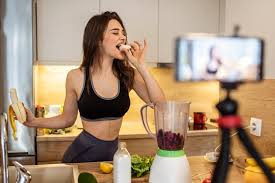
Hello everyone, and welcome to my fourth blog post, where I plan on comparing scientific evidence about healthy eating with information commonly promoted across social media. Platforms such as TikTok, Instagram, and Youtube are all major sources of nutritional advice, exposing individuals to trends, influencer reccomendations, and “healthy” content. While some information may be accurate, most of it is influenced by marketing, sponsorships and appearance focused trends. By comparing both research studies with social media claims, I hope to better understand whether society’s understanding of healthy eating is primarily based on science or online culture.
Research shows that social media influences how individuals understand nutrition and healthy eating habits (1). Studies illustrate that students often experience stress surrounding food choices and body image due to the constant exposure to diet and wellness content online (1). Scientific evidence suggests that healthy eating must focus on balance, moderation, and long term health. However, social media trends promote unrealistic standards that often negatively impact our physical and mental well-being (1). This demonstrates that social media often contradicts scientific recommendations, encouraging unhealthy expectations.
Studies also explain how algorithms influence our perceptions of healthy eating (2). Once people interact with fitness, or diet content, social media platforms continue recommending similar posts repeatedly (2). Over time, repeated exposure make unrealistic standards appear normal and accurate, even when there is little evidence supporting them (2). This shows how social media shapes beliefs about nutrition through repetition.
Many influencers promote diets such as keto diets, juice cleanses, and “clean eating” as the healthiest lifestyle choices (3). However, experts explain that such trends are influenced by sponsorships, personal opinions or marketing strategies rather than scientific evidence (3). Research explains that influencers use emotional appeal to market products as healthy (3). Scientific evidence, however, emphasizes that no diet works for everyone and that balanced eating habits are more sustainable (3). This demonstrates a clear contradiction between social media messaging and evidence based advice.

Research focused on such diet cultures highlight how harmful online trends can affect ones perception of what is healthy (4). Studies found that videos promoting weight loss, and unrealistic body standards lack scientific support (4). Evidence instead emphasizes overall health, and mental well-being rather than our appearances. This also demonstrates how social media trends oversimplify nutrition by creating misleading ideas about wellness.
Another major issue includes the spread of misinformation online (5). Researchers explain that false nutrition advice spreads rapidly due to social media content gaining attention, views and engagement (5). Scientific information is often more detailed, making it hard to communicate in short, eye-catching videos (5). This difference allows misinformation to spread faster than evidence-based advice (5). As a result, many believe nutritional myths without verifying whether information is supported by research.
Social media affects body image amoung teenagers and young adults (6). Constant exposure to diet culture, and fitness conetn often pressures individuals to compare themselves to unrealistic standards (6). Studies have linked appearance-focused content to anxiety, low self-esteem and unhealthy eating behaviours such as skipping meals (6). This demonstrates how social media promotes certain lifestyles as healthy, while they are harmful.

False nutrition advice spreads quickly online because social media content is designed to attract attention while spreading engagement (7). Many influencers promote trends such as detox teas, calorie deficits or cutting out food groups without evidence to support such claims (7). Evidence explains that balanced eating habits and moderation is much healthier than restrictive dieting (7). However, misinformation is often easier to spread because short videos simplify complex ideas into quick trends (7). For example, many influencers claim that eating late at night automatically causes weight gain, but scientific evidence shows that weight gain is closely related to overall calorie intake (8). Another common myth is that gluten-free diets are healthier for everyone, even though gluten-free diet
Overall, my research has allowed me to understand that social media only partially aligns with scientific evidence surrounding “healthy” eating. While creators share some accurate information, many trends are shaped by marketing, sponsorships and influencer culture. While evidence supports balanced nutrition, and long-term health, social media promotes restrictive diets, unrealistic standards, and oversimplified advice. This highlights the importance of evaluating the content we digest, and relying on credible resources when making decisions regarding our wellness.
2. https://www.nationalgeographic.com/health/article/nutrition-social-media-science-misinformation
3. https://www.uottawa.ca/en/news-all/diets-social-media-avoid-disinformation-trap
4. https://pmc.ncbi.nlm.nih.gov/articles/PMC10865719/
5. https://pmc.ncbi.nlm.nih.gov/articles/PMC12845257/
6. https://www.nature.com/articles/s41390-025-04030-z
8. https://www.julienutrition.com/popular-social-media-nutrition-myths-debunked/

Hi Ishani, I really enjoyed reading your blog post! You did a very god job at explaining the differences between social media nutrition trends and actual scientific evidence. I liked how you included multiple examples, such as detox teas, clean eating, and calorie deficit trends, because it made your points more realistic and relatable to people our age who use platforms like TikTok and Instagram every day. I liked how you connected healthy eating to both physical and mental health instead of only focusing on appearance. Overall, your post was very informative, engaging, and made me think more critically about the nutrition advice I see online. If you’re interested in going further in your research, here’s a source you could use from the World Health Organization on healthy diets and nutrition misinformation.
https://www.who.int/news-room/fact-sheets/detail/healthy-diet
Hi Ishani,
this is a very well written and researched post! I love how you are focusing on how fast the spreading of misinformation is compared to evidence based advice due to social media. I really enjoyed how you added a few facts like about the algorithm design and the unrealistic standards that exist. Your post left me wondering if platforms have the ability to promote better health content, or do they just choose not to? Overall, your pos is very well written and I can’t wait to hear your conclusion as your topic has broadened my opinion on social media I found a source that you may find helpful for your further research, as it connects to your main topic.
https://pmc.ncbi.nlm.nih.gov/articles/PMC9608801/
Great blog post!
Hi Ishani! Your blog post clearly compares scientific facts with social media’s influence on healthy eating and shows how marketing and influencers can cause confusion. To make it even better, you could add some simple tips for readers on how to check if nutrition info on social media is trustworthy.