Round one of research

This is my round one research focusing on how habitat separation impacts animal ability to reach seasonal resources. Human activities like building roads, expanding farm and developing cities break large habitats into smaller , isolate patches this changes make it harder for animals to move freely and access food., water and shelter when they need the most sepaated habits can increase competition create risks during movement and disrupt natural timing of resource availability.
1.Disrupt of migration routes
Habitat separation breaks large , continuous landscape into smaller pieces which cut across the natural migration routes used by large herbivores . These animals depend on seasonal movement to follow rainfall, fresh grass built across these roads animals may be unable to pass through or may be forced to Take longer less suitable paths
2.Increased difficulty and risk of movement
Separating landscape make movement more difficult because habitat patches are further apart and separated by barriers . Large herbivores must travel longer distances across unsafe areas such as roads, settlements or open land with little cover . This is because it increases their energy use and expose them to danger like vehicle collisions peaching and predators.
3.Isolation of population
When habitats are divided , animal groups become separated and cannot easily interact with each other. This isolation limits mating opportunities between different groups leading to inbreeding . If it is prolonged it reduces genetic diversity which is important for disease resistance and adaptation to environmental changes.
4.Increased human wildlife conflict
As migration routes are blocked herbivores in response , humans may use fences ,chase animals away or even kill them which further restricts movement and reduces population numbers.
5.Disruption of ecosystems processes
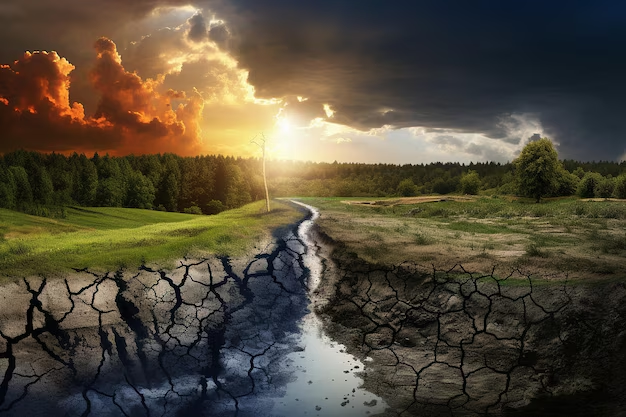
Large herbivores play a key role in maintaining ecosystems by grazing vegetation ,dispersing seed and cycling nutrients acrosss wide areas . when separation restricts their movement, these processes are disrupted . some areas may experience heavy grazing because animals are confined there , while other areas may have little or no grazing leading to overgrown vegetation
6.Habitat loss and reduced resources
Separation usually goes hand in hand with habitat loss . meaning that the total area available for herbivores become smaller with less land there is less food, water and shelter to support large populations .This is especially critical during dry seasons . when resources are reduced.
7.Creation of barriers
Human made structures such as highways , railways ,fences and urban areas act as a physical barriers that prevent or limit animal movement . Some barriers like high fences completely block migration routes while others like roads may discourage animals due to noise and activities that take place in that area
8.Edge effects
large migratory herbivores rely on movement to respond to seasonal changes droughts and climate variability when separation limits this movement animals cannot easily relocate to better conditions . For example during drought they may be unable to reach areas with water or fresh vegetation
Conclusion
Habitat separation reduces landscape connectivity by breaking habitats into smaller isolated patches and limiting the ability of large herbivores to move freely
Sources
1,Tiang D.C.F(2021).Ecological connectivity in seperated landscape
2.Lenore Fahrig (2003)Effects of habitat separation on biodiversity
3.Haddad N.M(2015)Habitat separation and its lasting impact on earth ecosystem science
4.Rossett M.R(2017) impact of habitat separation on herbivores
5.HILTY J(2020)Guidelines for conserving connectivity through ecological network and corridos

Hello Erastus, This critical study provides the missing link in our understanding of habitat and migration routs. I liked how you addressed your points from the top. thankyou for the good research.
Hello Erustus, as human activity reshapes landscapes, this calls for a good knowledge on this to protect what belongs to us. Thankyou.