
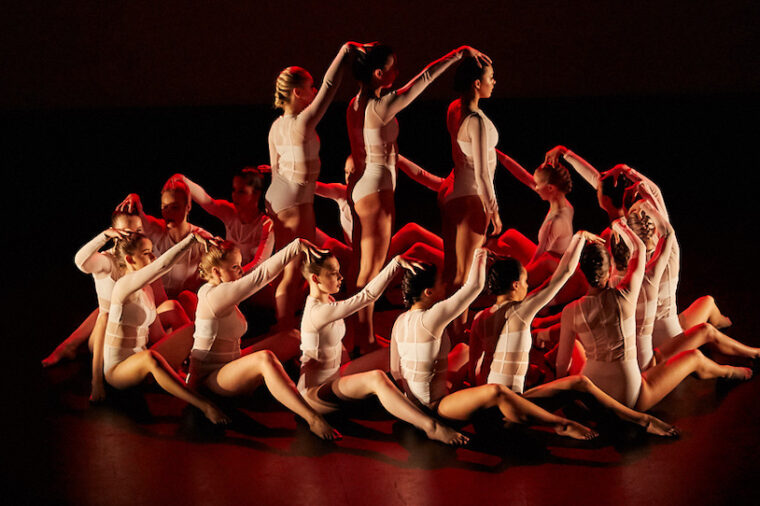
Hello! Thank you for taking the time to read my blog post again! For my semester 2 project, I am continuing to explore my inquiry question, “How does storytelling through movement and performance create a deeper impact than spoken language?” In this post, I will be focusing on the third step of my project plan: analyzing real-world performances and expert research on how movement is intentionally built as a storytelling system. This step is important because it goes beyond just emotional expression and looks at how meaning is actually constructed in choreography and interpreted by audiences through different psychological, cultural, and artistic lenses.
Research showed that movement in performance is often not random or just expressive, but carefully made as a structured form of communication. Elements like timing, spacing, repetition, and dynamics all help create meaning without the need for words (2). Choreographers intentionally use these movement choices to guide the audience’s attention and build a sense of story, similar to how writers use structure and language in writing books (4). This shows that dance can work almost like a “language of the body,” where meaning is created through patterns and movement rather than spoken explanation (2).

Studies on non-verbal communication show that people naturally assign meaning to body movement, even when no story is clearly explained (1). This happens because the brain is constantly reading posture, gestures, and movement as signals of emotion or intention, even in everyday life (1). In performance, this means audiences aren’t just watching movement passively, but they are actively interpreting it based on instinct, personal experience, and cultural understanding (1). Because of this, meaning in dance is not just sent from performer to audience, but created between both sides.

Neuroscience research also shows that when we watch movement, our brain can activate similar systems to when we actually perform that movement ourselves (3). This is linked to something called embodied cognition, where we don’t just understand movement logically, but we rather feel it in a more physical or emotional way (3). This can make the experience more memorable and emotionally engaging, because it involves both the mind and body. In comparison, spoken language mainly activates language-processing areas of the brain, which can make it feel more structured and less physically immersive (3).
Another interesting idea from research is that ambiguity in movement is actually intentional in many performances (5). Unlike spoken language, which usually gives a clear message, movement allows space for interpretation, meaning different people can understand the same performance in different ways (5). This makes the experience more personal, because audiences connect what they see to their own emotions and experiences instead of receiving one fixed meaning (5). In this way, the audience becomes part of completing the story rather than just receiving it.

Real-world performance studies show that choreographers use specific tools like contrast, repetition, and spacing to build meaning within a piece (4). For example, changes in speed or direction can show emotional shifts, while repeated movements can represent ideas like memory or tension (4). This shows that movement is not just expressive in the moment, but carefully planned, almost like storytelling techniques used in film or writing (4). On a broader level, research also shows that movement can cross language barriers because it relies on shared human experiences like emotion, tension, and physical expression (1). At the same time, interpretation can still vary depending on culture and personal background, which adds even more depth to how meaning is understood (5).

Overall, this step of my research shows that movement-based storytelling is not just about emotion, but about structure, interpretation, and communication happening at the same time (1, 2, 3, 4, 5). Unlike spoken language, which often delivers a more direct message, movement creates a layered experience where meaning is built and understood through both the performer and the audience. This helps me better understand my inquiry question, because it shows that the power of movement comes not only from what is shown, but from how people interpret and emotionally connect with it. Thank you for reading my final step for my inquiry question!
Article 1: https://storyingwithdavid.com/nonverbal-communication-and-storytelling-8aadfb802f5a
Article 2: https://www.akdaniel.co.uk/single-post/2019/05/13/storytelling-performance-part-3c-non-verbal-engagement-strategies-in-performance-storyt
Article 3: https://pmc.ncbi.nlm.nih.gov/articles/PMC11221573/
Article 4: https://methods.sagepub.com/book/mono/analyzing-narrative-reality/chpt/performance
Article 5: https://journals.uclpress.co.uk/r4a/article/id/1436/

Great post! I liked how you explained that movement can tell a story without using words. Your research gave me a new perspective on how audiences connect with performances.
This is a really interesting and well explained post. I like how you show that movement works like its own language and isn’t just random expression. This link may be able to help you with futur research on this topic! https://www.ted.com/talks/wayne_mcgregor_a_choreographer_s_creative_process
HI! Great post! I really liked how well-researched and organized this blog post was. The explanations were clear, and using multiple reliable sources helped support the inquiry question effectively. One area for improvement could be including a specific example of a dance or performance to help readers better connect the research to a real-world situation for better understanding of what you are talking about. Overall, it was an informative and post that clearly showed a strong understanding of the topic.
Hi Timothy!
I really enjoyed reading your post and found it interesting how you explained that movement not only expresses emotion, but also a structured form of communication through timing, spacing and choreographic choices. Your research was extremely interesting and allowed me to understand how movement-based storytelling can have a powerful impact, without spoken words. Are there any specific dance performances that you find particularly effective at telling a story through movement alone?
https://www.lynnpantingdance.com/choreographing-connection/how-movement-shapes-storytelling
https://mikeganino.com/beyond-words-how-physicality-and-vocal-presence-shape-your-storytelling-impact/
I loved this topic so much!! I thought your blog post was very engaging because you clearly explained complex ideas in a way that was easy to understand. Your discussion about movement acting as a “language of the body” was particularly interesting and helped support your inquiry question. To make your post even stronger, you could include more information about how different types of dance or performance use movement to tell stories in unique ways. Overall, I really enjoyed reading your post, its so unique and intriguing; really goes into how psychology and body analysis has a part in so many different aspects of life.
I really liked how you explained movement as a “language of the body” and connected choreography techniques like timing, spacing, and repetition to meaning-making in performance. Your point about audiences actively interpreting movement rather than just receiving it was especially strong, because it shows how storytelling becomes a shared experience between performer and viewer. I also found your idea about embodied cognition really interesting, since it connects science and art in a way that helps explain why movement can feel so emotionally powerful. Do you think certain styles of dance or performance make this effect stronger than others? Good work on your post, I enjoyed reading it!