
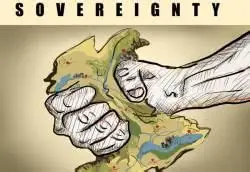
Political sovereignty has traditionally been connected to physical territory, fixed boarders and centralized governments since development of the modern nation system , sovereignty has generally meant that government exercises supreme authority within clearly defined geographic boundaries.
Governance without the state
The theory of governance without the states examines how social order and political organization can emerge even in absence of centralized territorial governments. Researchers in this field study communities, regions and organizations where governance is maintained through customs, social, economic co-operation, religious systems or decentralized authority structures rather than formal state institution example includes; tribal , indigenous corporation, online communities and non-governmental organization. The systems demonstrate that governance does not require a single sovereign authority controlling territory.
Digital sovereignity

refer to ability of individuals or institutions to exercise control over digital infrastructure , data communication systems and online governance .In traditional states , sovereignty depends on controlling land and population within boarders. This concept has become especially important because global technology platforms now shape communication, identity, commerce and even political participation across boarders. Governments are also attempting to assert digital sovereignty by regulating data flows , cyber security and internet infrastructure within their jurisdictions.
Self-sovereignty identity
This is the idea that individual should fully control their own digital identities without dependence on governments , corporations or centralized institutions. This concept is important in discussions of borderless sovereignty because it weakens the connection between identity and territorial citizenship . In the future , individual may participate in digital communications or governance systems simultaneously because it weakens the connection between identity while maintaining portable identities that function globally . Advocates argue that self sovereign identity can increase privacy , personal freed and digital autonomy , while critics warn about security risks, reregulation challenges and inequalities in technological access.
Polycentric Governance
This describes systems where multiple centers of authority operate simultaneously rather than a single centralized government controlling all aspects of society. In modern life people already governed by overlapping institution including national governments , local authorities , international organizations , cooperation , financial systems and digital platforms