Hello and welcome to my blog post #3, my first round of research. In this post, I will be researching how sleep affects your brain. In this step, I will be researching the basic science of sleep to understand what sleep does for memory, focus, and learning, which will eventually help me to solve my overall question.

What happens in our brain when we sleep?
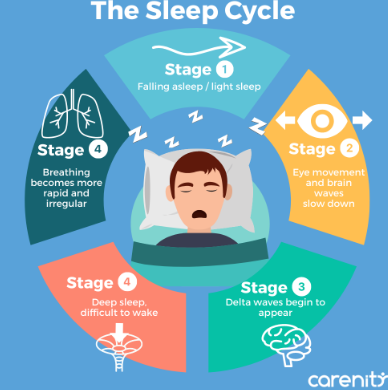
The brain is always working, even when we are sleeping. Sleep is not just resting it is a time when the brain can organize information, repair, and prepare for the next day. When students don’t get enough sleep, the brain cannot do these things, which can make learning and focusing much more difficult (1). For example, students who stay up late doing homework or watching T.V can feel tired, forgetful, or even unfocused the next day because their brain didn’t get enough time to recover and prepare (2). While you sleep, the brain can go through many different stages, including light sleep, deep sleep, and REM sleep. Each stage helps the brain differently. Deep sleep helps store memories and keep the body healthy, and REM sleep helps your creativity, problem‑solving, and emotional control (2)(3). Without enough time in these stages, students can forget information more easily, or feel stressed and overwhelmed (1)(4). For example, if a student doesn’t get enough REM sleep, they may feel more emotional the next day, which can affect how they learn and behave in class (2).

How does sleep affect our memory?
One of the most important things that sleep does is help with our memory. When students learn something new, the brain needs to store that information while they sleep. This is called memory consolidation, and it is when you sleep after learning, which can consolidate information into memories, allowing you to store them in your brain (2). For example, if a student studies or memorizes, the brain needs sleep afterwards to save that information. Without enough sleep, the brain may forget things faster or struggle to keep new information organized (3). Students who get enough sleep are more likely to remember what they learned in class, do better on tests, or understand new concepts better (4). But students who don’t sleep enough may feel like they studied but didn’t actually remember anything, which can show how important sleep is for learning (2).
How does sleep affect focus and attention?
Sleep plays a huge role in how well students can focus. When students don’t get enough sleep, their reaction time slows down, and they may have trouble paying attention in class(1). They might also zone out during class, need to reread the same sentence, or even forget instructions. This happens because the part of the brain that controls our focus and decision-making doesn’t work as well when we are tired (4). Lack of sleep can also make students feel more stressed. Without enough REM sleep, students can feel overwhelmed or anxious, which makes it even harder to concentrate in school (3). For example, a tired student may feel upset over small and unnecessary things, which affects their learning. (4) Students who regularly get less than the recommended 8 hours of sleep often have worse grades, more difficulty paying attention, and more trouble remembering information (1). This shows how much our sleep affects school performance.
Why This Matters
So why does this actually matter? Well, understanding how sleep affects the brain shows why getting enough sleep is so important for students. Sleep affects memory, focus and problem‑solving and without enough sleep, the brain cannot work the best, which affects everything (1)(4). So if a student wants to do well in school, sleep is one of the most important things.
References
Brain Basics: Understanding Sleep | National Institute of Neurological Disorders and Stroke (1)
How Memory and Sleep Are Connected(2)
The Glymphatic System: How Your Brain Washes Itself During Sleep (3)